

Welcome to Part 5 of our Tax Series focused on “My Trust, My Tax: What Every Settlor, Trustee, and Beneficiary Should Know about the Nigeria Tax Acts 2025”.
Trusts have long been recognised as powerful legal and financial tools for managing wealth, protecting assets, and ensuring continuity across generations. They are increasingly relevant to families, entrepreneurs, professionals, and institutions seeking structured solutions for succession, governance, and long-term planning.
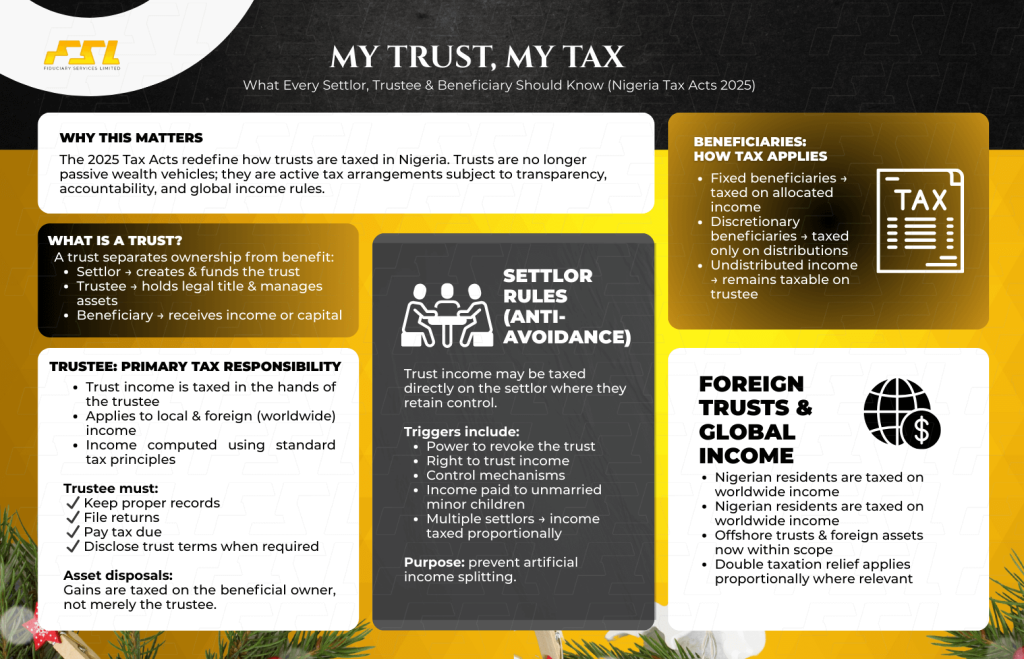
The defining feature of a trust is the separation between legal ownership and beneficial enjoyment. The trustee holds legal title to the trust assets and is responsible for their management, while the beneficiaries are entitled to benefit from those assets, whether by way of income, capital, or use.
The enactment of the 2025 Tax Acts marks a decisive shift in how trusts and estates are treated within Nigeria’s tax framework. The new provisions are not merely technical; they are strategic, designed to ensure that trust structures do not become vehicles for tax leakage, income diversion, or opacity. For settlors, trustees, and beneficiaries alike, proper structuring and administration have never been more critical.
Trustee
Under Nigeria’s tax framework, a trust is generally recognised as a separate taxable arrangement, with the trustee positioned as the first point of contact for tax purposes. Income earned by a trust is assessed in the hands of the trustee in their representative capacity, and this includes income from all sources, whether local or foreign, reflecting Nigeria’s expanded approach to taxing worldwide income. In practical terms, the trust income is computed using standard income tax principles. Authorised expenses and fixed annuities are deductible, while profits arising from business activities, rents, or investments are adjusted in the same manner as those of an individual taxpayer.
The trustees are required to maintain proper records of trust income and expenses, file tax returns, and account for tax on income arising within the trust, where applicable. This responsibility exists regardless of whether the trustee is an individual or a corporate trustee and failure to comply with the rules may expose the trustee to penalties, interest, and personal liability in certain circumstances.
They also have an obligation to disclose the terms of the trust to the tax authorities when requested for. Companies that are created under a trust also have the same corporate tax rules that relate to companies discussed in part two of the series.
Trustees, as managers of trust assets which include real property, shares, digital assets, vehicles, etc, bear primary responsibility for computing, reporting, and paying tax on trust income and gains made from the transfer of those assets, declaring transfers at market value, and keeping proper records. The Act did clarify that gains from asset disposals by trustees are attributed to the beneficial owner, ensuring tax liability falls on the true recipient. This ensures that tax liability rests with the true economic recipient, even where trustees act as intermediaries.
Settlor
The Settlor rules have also changed. A key anti-avoidance feature of the new framework is the adoption of a robust “look-through” rule. Where a settlor retains control over a trust, through powers of revocation, entitlement to income, or other mechanisms, the income of the trust may be taxed directly in the hands of the settlor. The rule also applies where income is paid to an unmarried minor child above the national minimum wage, or in situations involving multiple settlors, where income is attributed in proportion to each settlor’s contribution. These provisions are designed to prevent artificial income splitting and ensure that tax liability cannot be avoided through family or trust arrangements that lack genuine economic separation.
Beneficiaries
Beneficiaries are taxed based on their rights and actual benefits under the trust. Fixed beneficiaries are taxed on their allocated share of trust income, while discretionary beneficiaries are taxed only when distributions are actually made to them. Any income distributed is taxed in the hands of the beneficiary, while undistributed income remains taxable on the trustee.
Where trust income is sourced from outside Nigeria and distributed to beneficiaries, the acts provide for proportional relief to mitigate double taxation. Importantly, with Nigerian residents now taxed on worldwide income, distributions from offshore trusts, foreign accounts, or overseas assets are no longer beyond the reach of Nigerian tax authorities.
The Nigeria Tax Acts 2025 reinforce an important message: trusts are not passive vehicles. They are active legal and tax arrangements that demand informed decision-making and ongoing compliance. Taken together, these reforms signal a new standard for trust governance in Nigeria, one grounded in transparency, accountability, and alignment with global tax norms. Trusts remain powerful tools for wealth preservation and succession, but only when supported by deliberate structuring, robust documentation, and proactive compliance.
For families and advisers, the message is clear: tax planning can no longer be treated as an afterthought. Trustees, settlors, and beneficiaries must now engage more deeply with the tax implications of their arrangements, ensuring that trusts achieve their intended objectives without creating unintended fiscal exposure.
In the next part of this series, we turn to the taxman’s expanding reach into the digital economy, examining the rules surrounding Digital Assets and other forms of online wealth.
As part of our Wealth Preservation services, we have experienced Advisors ready to assist you in developing an estate plan that protects, preserves, and sustains you and your family’s wealth for generations.
Get in touch with one of our professionals today by sending an email to contact@fiduciaryservicesltd.com.