

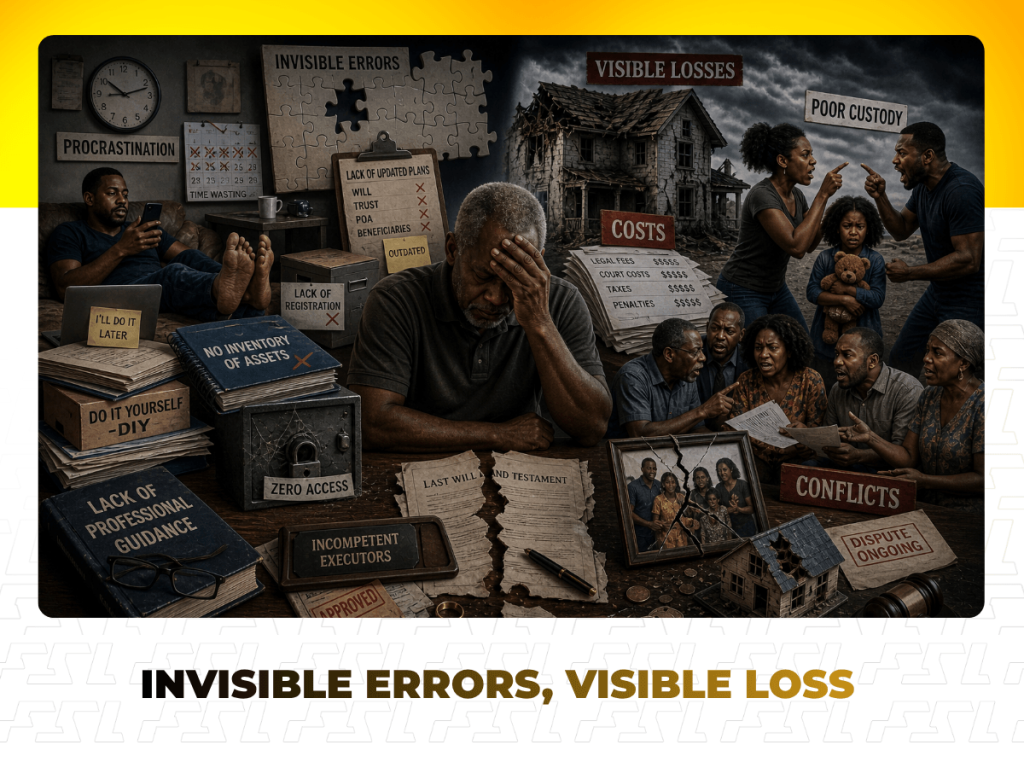
Welcome to the May 2026 edition of our Wealth Office newsletter. This edition focuses on protecting your wealth, family, and legacy by addressing the invisible errors that often lead to visible losses.
Most estate planning failures do not begin with obvious mistakes. They begin quietly with assumptions, delays, and overlooked details.
On the surface, everything may appear to be in place. A Will exists. Assets have been acquired. The family is aware that “something has been done.” There is a sense of comfort in that assumption. Yet, beneath that surface, small gaps begin to form. Over time, those gaps compound, and when the moment of transition arrives, they translate into real, measurable loss.
A well-known example is the Tony Hsieh estate, where a $500 million estate descended into confusion after a questionable Will surfaced years after his death. The document referenced unknown beneficiaries, unverifiable witnesses, and entities no one could confirm. Yet, it still triggered a full legal battle and reopened an Estate that had already been assumed settled.
The lesson is simple: it does not take much for confusion to enter an Estate, and once it does, it is difficult and expensive to contain.
However, while this may read like a billionaire’s problem, the underlying issues are not unique to large estates. The same gaps unclear documentation, poor record-keeping, weak structuring play out every day, including in Nigeria, just on a different scale.
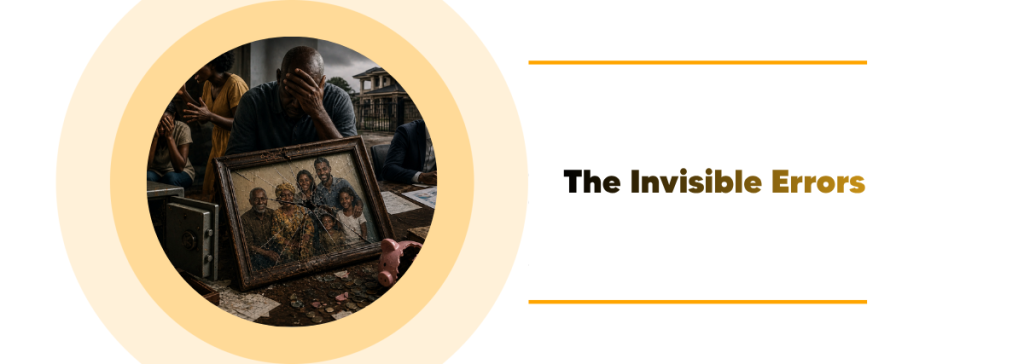
These are not always technical failures. More often, they are behavioural and practical gaps that quietly undermine even well-intentioned plans:
Procrastination is one of the most common. Estate planning is delayed because it does not feel urgent until it is. By then, it is often too late.
Closely linked is the assumption of Time. Many people begin the process but delay completion, believing there will always be another opportunity to finalise it. In reality, partially completed plans offer no protection.
This leads to a frequent and costly gap: starting but not completing the process. Instructions are given, drafts are prepared, but documents are never properly executed or witnessed. Legally, this is the same as having no plan at all.
Even where plans exist, they are rarely updated. Life evolves; marriage, children, new assets, business growth, but estate plans remain static. Over time, they become outdated and misaligned with reality.
Another critical issue is failure to properly store or register estate documents. Wills are kept in private custody, unknown locations, or with individuals who cannot produce them when needed. In Nigeria, failure to lodge a Will at the Probate Registry creates a real risk that it may never be found or may be challenged.
Poor documentation of assets and available assets inventory is perhaps the most damaging. Families may know that assets exist, but lack the specifics; bank account numbers, investment records, property documents, or access details for digital assets. Without these, the assets are effectively hidden.
There is also an over-reliance on verbal instructions. Intentions are shared informally but never legally documented. At the point of administration, verbal wishes carry little to no weight.
Another error is executors are often appointed based on trust or familiarity, rather than competence and capacity. Yet this role requires organisation, neutrality, and the ability to navigate legal and financial systems.
Furthermore, In many cases, there is no coordination across assets. Wealth is spread across banks, registrars, properties, and digital platforms, but there is no central record or integrated plan tying everything together.
Finally, there is a tendency to avoid professional guidance. Partial advice or do-it-yourself approaches often result in plans that appear valid but fail in execution.
These are not extreme errors, but they are common and that is precisely why they are dangerous.
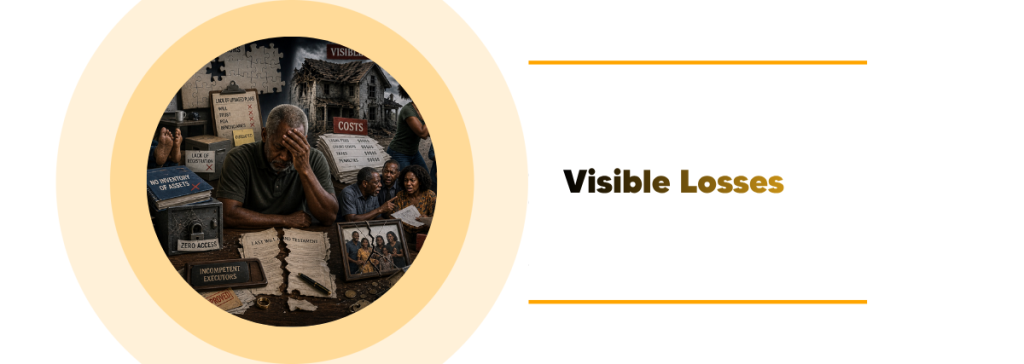
It is at the point of transition that invisible errors, the gaps become impossible to ignore.
The first and most immediate issue is access. Financial institutions do not act on assumptions or family knowledge. They require precise, verifiable details, account numbers, ownership records, and valid authority before granting access to any asset. Where these details are missing, access is delayed or entirely blocked. Bank accounts remain frozen. Investment portfolios cannot be managed or liquidated. Even where the family knows assets exist, without the necessary particulars, those assets are effectively out of reach.
In practical terms, this means the Estate may be valuable on paper, but inaccessible in reality. This quickly leads to financial strain. Probate fees, taxes, and administrative costs must be paid. Without access to funds, families are forced to use personal resources, borrow, or sell assets under pressure.
At the same time, value begins to erode. Properties remain unoccupied and deteriorate. Investments are left unmanaged. Businesses lose direction and momentum. In urgent situations, assets are sold below market value simply to raise cash.
Costs also increase unnecessarily. Legal and probate expenses rise due to avoidable complications. Tax liabilities may be higher than necessary, with penalties and interest compounding the issue.
Furthermore, where businesses are involved, the impact can be immediate. Accounts cannot be operated, decision-making is delayed, staff and stakeholders lose confidence, and over time, the enterprise value declines.
Control may also shift in unintended ways. In the absence of clear structures, the law steps in and distribution may follow default rules rather than personal intention, and individuals who were never meant to manage the estate may find themselves in control.
Finally, conflict emerges. Uncertainty leads to disputes, delays create pressure and pressure leads to breakdowns in relationships. What should have been a structured transition becomes prolonged, costly, and emotionally draining.

Avoiding these outcomes requires intentional planning; not just documentation.
- Estate planning should be treated as a process, not something you do once and forget. It should be reviewed regularly and updated as life changes.
- A Will is important, but it is not enough on its own. There should be proper structure around assets, sometimes through trusts or corporate arrangements to ensure continuity and control.
- Asset details must be properly documented. This is critical. Without clear records especially bank and investment details, financial institutions cannot act.
- Documents should be properly executed, stored, and where appropriate, lodged with the relevant registry so they can be found when needed.
- Executors should be chosen for their ability to act, not just their relationship to you.
- There should also be some level of liquidity planning, so the estate can function immediately without distress.
- And most importantly, everything should work together. Legal, financial, and practical considerations should be aligned, not handled in isolation.
Conclusion
Estate planning is not where wealth is created; it is where wealth is either preserved or lost. The most expensive mistakes are rarely the obvious ones. They are the silent gaps that only become visible when it is too late to fix them.
Structure early. Review consistently. Integrate properly. Make it accessible.
At Fiduciary Services Limited, we work with individuals and families to move beyond basic estate planning into fully structured, practical, and executable wealth transfer strategies.
From drafting and reviewing Wills, to setting up Trusts, structuring assets, documenting holdings, and acting as professional executors or Trustees, we ensure that your estate is not just planned but available to beneficiaries when it matters most.

As part of our Wealth Preservation services, we have experienced advisors ready to assist you in developing an estate plan that protects, preserves, and sustains you and your family’s wealth for generations.
Get in touch with one of our professionals today by sending an email to contact@fiduciaryservicesltd.com. To book a FREE CONSULTATION click link: bit.ly/4sjQDLV
Regards,
Mercy Edukugho-Aminah
mercyaminah@fiduciaryservicesltd.com
+234 803 726 5961