

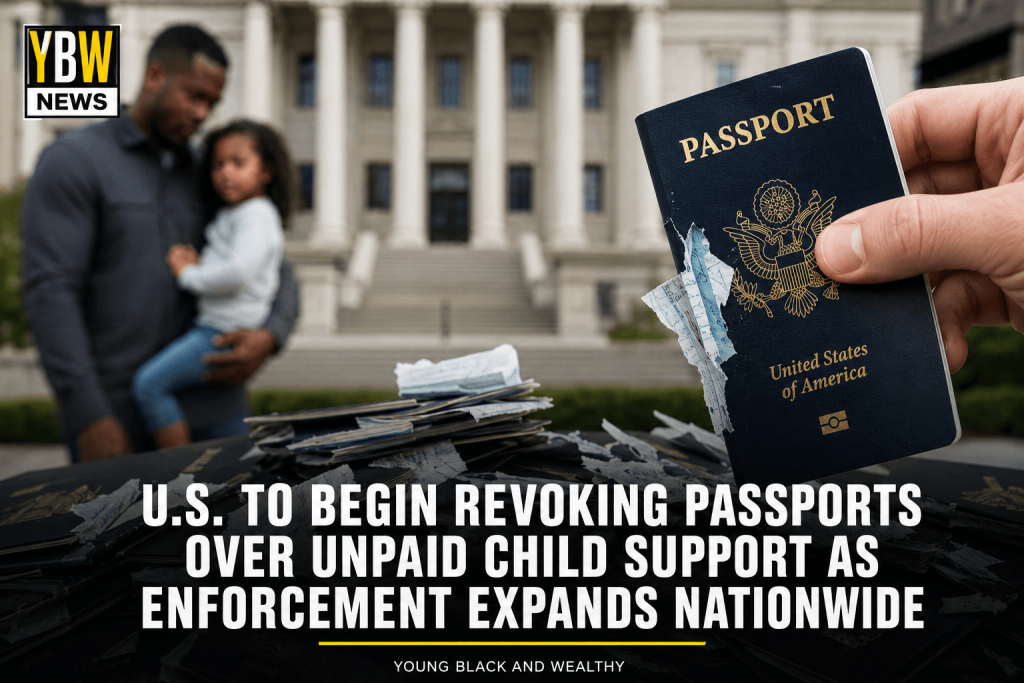
The U.S. State Department has announced a significant escalation in its enforcement of child support obligations: Americans with unpaid child support debt will have their passports revoked, effectively grounding them from international travel until those debts are resolved. Revocations began in May 2026, initially targeting parents owing $100,000 or more, approximately 2,700 American passport holders with plans to rapidly expand the programme to cover all parents owing more than $2,500, the threshold set under a 1996 federal law that has, until now, seen only limited enforcement.
The policy’s implications extend well beyond domestic child welfare enforcement. For internationally mobile professionals, globally active entrepreneurs, and dual-resident families with financial obligations spanning multiple jurisdictions, this development introduces a new and immediate mobility risk, one that can materialise with little warning and has no quick resolution.
What Has Changed, and Why It Matters
This is not an entirely new law. The Passport Denial Programme has existed since the late 1990s under the Personal Responsibility and Work Opportunity Reconciliation Act of 1996. What has changed is the scale and mechanics of its enforcement, and that distinction is critical.
Until recently, the 1996 law functioned primarily as a tripwire: parents who owed arrears above $2,500 were flagged only when they applied for a new passport or sought to renew an existing one. The new policy dismantles that passive enforcement model entirely. Under the updated approach, the Department of Health and Human Services will inform the State Department of all past-due payments exceeding $2,500, and parents in that group with valid passports will have their documents proactively revoked, regardless of whether they have any upcoming travel plans or pending passport applications.
The practical consequences are immediate and severe. Once a passport is revoked, it may no longer be used for travel. Eligibility for a new passport will only be restored after the child support debt is paid in full to the relevant state child support enforcement agency and the individual is no longer recorded as delinquent in HHS records. Even after payment is confirmed, the clearance process takes a minimum of two to three weeks. For those who travel regularly for business or maintain international obligations, this is not an administrative inconvenience, it is a full disruption of professional and personal mobility.
The exposure for Americans already abroad is even more acute. Americans overseas at the time of revocation face an immediate crisis: they will need to visit a U.S. embassy or consulate to obtain an emergency travel document valid only for direct return to the United States. No second passport, no alternatives.
The Legislative Direction of Travel
This policy shift is not occurring in isolation. H.R. 6903 passed the U.S. House of Representatives by voice vote on April 27, 2026, and would amend the underlying statute to clarify that passport revocation is a mandatory enforcement remedy, not merely an available option. If enacted into law, this would remove the current discretionary element from the programme, making revocation automatic upon certification of qualifying debt, further narrowing the window for affected individuals to act before their mobility is curtailed.
The direction is clear: financial non-compliance and travel freedom are being formally and increasingly linked within U.S. domestic policy. This reflects a wider trend of governments using travel documentation and mobility restrictions as enforcement tools connected to financial and legal compliance obligations, a trend that has significant implications for how internationally mobile individuals structure and manage their global footprint.
Who Is Actually Affected?
At first glance, this may appear to be a narrow enforcement measure targeting a specific category of domestic delinquency. In practice, the affected population is broader and more diverse than the framing suggests.
Consider the internationally mobile professional; an American executive or entrepreneur living and working abroad, managing cross-border business interests, and subject to a child support order in a U.S. state. The logistics of compliance, currency conversion, and cross-border payment may have created arrears, inadvertently or otherwise. Under the previous passive enforcement model, the issue might have surfaced only at renewal. Under the new model, their passport could be revoked at any time, mid-assignment, mid-contract, mid-travel.
Consider also the dual-resident family navigating separation or divorce across jurisdictions, where legal proceedings in one country have not yet been reconciled with obligations in another. The intersection of family law, international mobility, and domestic enforcement mechanisms creates a landscape where exposure can accumulate quietly, until it does not.
The $2,500 threshold, while modest relative to the financial profiles of many internationally active individuals, is low enough to capture a wide range of circumstances, including those arising from administrative delays, legal disputes over payment amounts, or simple gaps in cross-border remittance.
A Proactive Mobility Strategy, Not a Reactive Fix
In an environment where a single domestic financial obligation, even a contested or inadvertent one can ground an internationally active individual indefinitely, relying on a single passport as the sole instrument of global mobility is an increasingly fragile planning position.
This is where second citizenship, obtained through legitimate and established Citizenship by Investment (CBI) or residency pathways, transitions from a privilege to a planning essential. For globally mobile individuals and families, holding a second passport from a stable jurisdiction provides a critical layer of continuity ensuring that professional commitments, business travel, and family mobility are not held hostage to the enforcement posture of any one government at any given time.
This is not about circumventing obligations. Legal and financial obligations must be met, and no mobility strategy substitutes for compliance. Rather, it is about ensuring that while compliance matters are being resolved , through payment arrangements, legal proceedings, or administrative processes, an individual’s ability to operate internationally is not simultaneously suspended.
At Fiduciary Services Limited, we support clients in building global mobility frameworks that are resilient, compliant, and integrated with their broader financial and legacy objectives. In a world where travel documentation is increasingly tied to financial compliance, our Citizenship by Investment services are designed to help clients:
- Identify second citizenship or residency jurisdictions aligned with their travel, business, and family needs
- Understand the legal and tax implications of dual citizenship across relevant jurisdictions
- Integrate mobility planning with wealth preservation, succession, and estate objectives
- Anticipate and manage cross-border financial compliance risks before they become mobility crises
The U.S. passport revocation policy is a timely illustration of a broader reality: in today’s regulatory environment, global mobility is not guaranteed by the document in your pocket. It must be planned for, structured, and protected, just like any other strategic asset.
For individuals and families with international lives and obligations, the question is no longer whether to plan for mobility resilience, but how urgently.