


For many Nigerian families, the return to school brings more than excitement—it brings the familiar weight of school fees, books, uniforms and examination costs. But beyond meeting these expenses today lies a more important question: what happens to our children’s education if the person providing for it is no longer able to? Following our recent conversations on Waqf as a means of building self-sufficient mosques, strengthening family wealth and preserving family businesses, this edition explores Education Waqf—a powerful way to secure our children’s educational future while creating a legacy of continuous reward.
In this month’s thought-provoking piece, Abbas Adam Abba explores how families and educational institutions can harness Waqf to make education more sustainable and ensure that a child’s future does not depend solely on the continued income of a single breadwinner.
In the Name of Allah, the Most Gracious, the Most Merciful.
Allah(swt), the Most High, says:
“Never will you attain righteousness until you spend from that which you love. And whatever you spend, indeed Allah is Knowing of it.”
(Qur’an 3:92)
This verse inspired Umar ibn Al-Khattab (RA) when he acquired a valuable piece of land in Khaybar. He went to the Prophet (peace and blessings be upon him) seeking advice on the best way to utilize it. The Prophet (SAW) said:
“Retain the original property and dedicate its benefits as charity.”
(Sahih al-Bukhari and Sahih Muslim).
From this guidance emerged the institution of Waqf (Islamic Endowment), which continues to feed the poor and the needy, while financing mosques, hospitals, and educational institutions in different parts of the world.
Let us now reflect on the situation facing many families today.
Every year, as the month of September approaches, countless families across Nigeria experience a familiar season of anxiety.
Not because of illness.
Not because of hunger.
But because of SCHOOL FEES.
One day, a father returned home from work or his business. He found his children excited because they had completed the previous academic session and were looking forward to resuming in a new class.
But his own heart was filled with worry.
His wife handed him a pile of bills:
- School fees
- Registration fees
- Uniforms
- Books
- Exercise books
- School sandals
- Transportation
- NECO examination fees
- WAEC examination fees
- JAMB registration fees
- TAHFIZ graduation expenses.
He remained silent.
While the children celebrated with excitement, tears filled their father’s eyes.
At this time of the year, many parents begin to experience severe stress, and some even suffer from high blood pressure because they simply do not know how they will pay these educational expenses. The Daily Trust newspaper of 1 August 2026 highlighted how the rising cost of education is placing enormous pressure on Nigerian families.
An Important Question:
1. What happens if this father dies?
2. What if he retires?
3. What if his business collapses?
4. What if he loses his job?
In many cases, the consequences are heartbreaking:
- Children are forced to drop out of school.
- Some cannot afford to sit for WAEC or NECO examinations.
- Others lose the opportunity to enter university because they cannot pay admission or registration fees.
- The educational dreams of the entire family collapse within a very short time.
Sadly, even in wealthy families, once the breadwinner dies, many children discontinue their education within one or two years because there is no sustainable financial system to support them.(I am an eye witness because of being a school proprietor for decades).
Is There a Solution?
YES.
The solution is Education Waqf (Educational Endowment).
The Prophet (peace and blessings be upon him) said:
“When a person dies, all his deeds come to an end except three: ongoing charity (Sadaqah Jariyah), beneficial knowledge, or a righteous child who prays for him.”
(Sahih Muslim)
Reflect carefully upon this hadith.
Education Waqf combines two of these three lasting rewards at the same time: ongoing charity through Waqf and beneficial knowledge through education.
Therefore, establishing a Waqf to support children’s education is among the greatest investments for continuous reward after death.
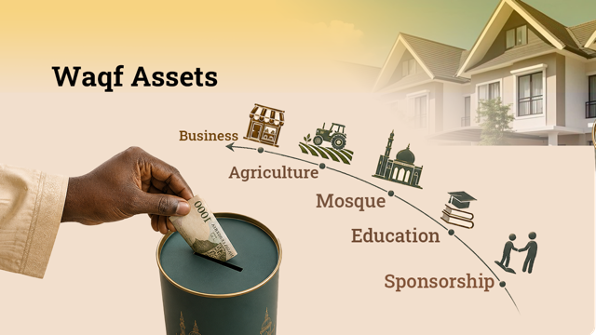
How Can Family Education Waqf Solve This Problem?
Imagine if every family, while still financially stable, sets aside 5% to 10% of its wealth or income to establish a Family Education Waqf.
The fund would then be invested only in Shariah-compliant investments.
The investment returns could permanently finance:
- School fees
- Books
- Uniforms
- WAEC fees
- NECO fees
- JAMB registration
- University admission expenses
- TAHFIZ education
- Islamic school fees
- University tuition… etc.
Even if the father dies…
Even if he retires…
Even if the family’s business fails…
The children’s education will continue uninterrupted.
Schools Can Also Establish Education Waqf.
Both conventional and Tahfiz schools can establish their own Education Waqf Fund.
The Waqf assets may include:
- Agricultural farms
- Commercial shops
- Orchards
- Shariah-compliant investment portfolios
The income generated from these Waqf assets can be used to:
- Reduce school fees
- Sponsor orphaned students
- Assist underprivileged students
- Pay teachers’ salaries
- Construct additional classrooms
- Provide books and educational materials
- Pay WAEC, NECO and JAMB fees for deserving students
- Sponsor Tahfiz graduation ceremonies
This enables schools to rely increasingly on sustainable investment income instead of constantly increasing school fees.
This Is What Islamic History Demonstrates
For centuries, many Muslim schools and universities flourished because of the Waqf system.
Students pursued education with peace of mind because Waqf institutions financed their learning—from primary education to university..and Tahfiz graduation.

The time has come for families to stop leaving their children’s education dependent solely on one person’s monthly salary or business.
The time has come for schools to stop relying only on increasing school fees.(as major source of income).
The time has come to establish Education Waqf.
So that education will not die because the breadwinner dies.
So that children’s dreams will not be destroyed by poverty.
So that every family leaves behind an educational legacy more valuable than houses and cars, etc.
Education Waqf is a legacy that continues educating children, paying their educational expenses, supporting teachers, and earning continuous rewards for its founder long after he or she has returned to Allah.
May Allah make us among those who establish Waqf to safeguard the education of our communities and secure the future of our children. Ameen.
Credit;
Abbas Adam Abba
Chairman, Alburhan Waqf Initiative, Kano
Tel: +234 803 856 9777
Email: abbasadamrz@gmail.com

Fiduciary Services Limited is committed to assisting Muslim clients in aligning their estate and business affairs with Islamic principles. Contact us today to ensure your legacy reflects your faith and values.
Get in touch with one of our professionals today by sending an email to contact@fiduciaryservicesltd.com. To book a FREE CONSULTATION click link: bit.ly/4sjQDLV
Shukran Jazeelan for reading.
Mercy Edukugho-Aminah
mercyaminah@fiduciaryservicesltd.com
+234 803 726 5961