

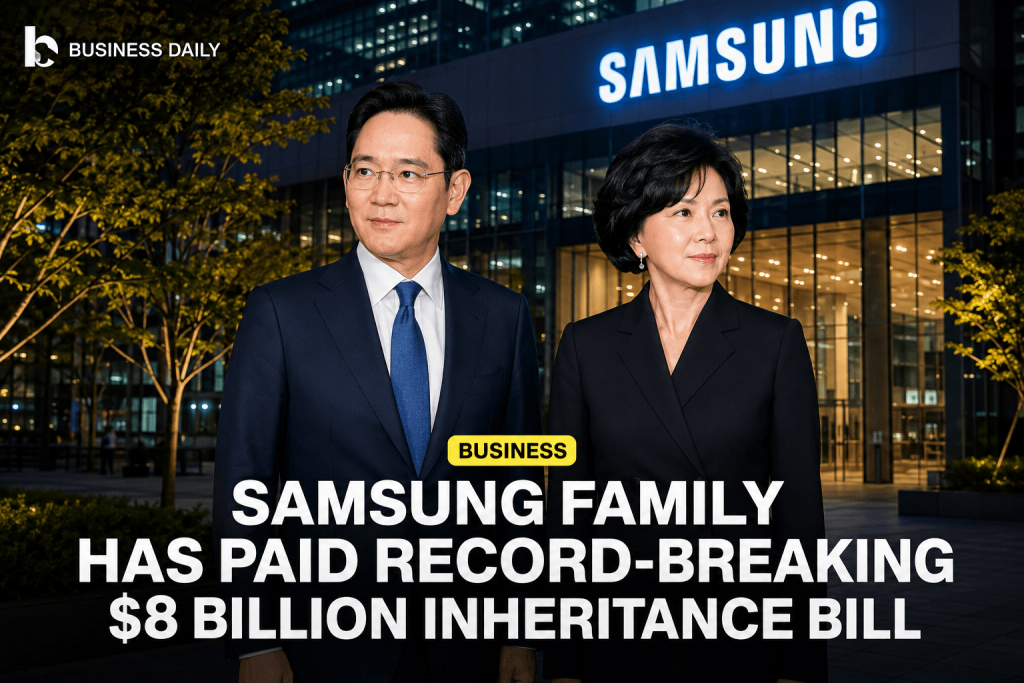
The recent conclusion of the largest inheritance tax settlement in South Korean history has drawn considerable attention from legal, financial, and governance circles worldwide, offering a compelling illustration of the complexities that attend the transfer of dynastic wealth across generations. The Lee family, controlling shareholders of Samsung Group, completed payment of a 12 trillion yuan inheritance tax bill, equivalent to approximately $8 billion in six instalments over the course of five years, following the death of late Chairman Lee Kun-hee in October 2020. The scale of the settlement, and the manner in which it was navigated, merits careful examination by high-net-worth families and their advisors.
The Estate and Its Composition
Lee Kun-hee left a fortune estimated at 26 trillion yuan, comprising corporate shareholdings, real estate, and one of the most significant private art collections in Asia. The breadth and diversity of this estate, spanning listed equities in one of the world’s largest conglomerates, illiquid physical assets, and culturally significant property illustrates the complexity that characterises wealth of this nature. Each asset class carries distinct valuation methodologies, liquidity profiles, and tax treatment considerations, all of which must be carefully anticipated within any robust succession framework.
Under South Korean law, the top inheritance tax rate stands at 50 percent for estates valued above 3 billion yuan, with shareholdings bequeathed by a company’s largest stockholder attracting an even higher effective rate of 60 percent. Applied to an estate of this magnitude, the resulting tax liability was, by any measure, extraordinary amounting to roughly one and a half times South Korea’s total inheritance tax revenue for the entirety of 2024.
Navigating the Liability: Structure and Strategy
What distinguishes the Samsung case is not merely the size of the tax obligation, but the deliberate manner in which it was discharged. The family availed itself of a deferred payment programme, filing in April 2021 and satisfying the liability in six structured instalments over the permitted period. This approach, where available under applicable law, reflects sound succession planning practice; preserving liquidity, avoiding forced disposals of core holdings, and maintaining operational continuity within the group.
Critically, the settlement was completed without major asset sales, aided in part by a significant appreciation in Samsung Electronics’ value driven by AI-related semiconductor demand. While market conditions favourable to the family cannot be attributed to planning, the ability to withstand a liability of this scale without relinquishing strategic holdings speaks to the underlying financial resilience that structured wealth management affords.
The settlement also had direct implications for the family’s corporate control. Chairman Lee Jae-yong’s stake in Samsung Electronics common shares rose from 0.70 percent to 1.67 percent following the inheritance, with similar increases recorded across Samsung C&T and Samsung Life Insurance. The outcome effectively consolidated rather than diluted family influence over the conglomerate , a result that would not have been assured absent careful navigation of the succession process.
The Philanthropic Dimension
The Lee family’s approach to the estate extended beyond tax compliance. The family donated more than 23,000 artworks, including designated national treasures to the South Korean state, in what constitutes one of the largest cultural donations in the country’s history. Separately, substantial charitable commitments were made to medical institutions, including a 700 billion yuan pledge toward the construction of an infectious disease hospital and a further 300 billion yuan directed to paediatric cancer and rare disease care.
These philanthropic dispositions serve a dual function in estate planning terms. They reflect the translation of a founder’s legacy into enduring institutional contributions, while simultaneously demonstrating the value of deliberate, pre-planned charitable giving as a component of overall estate strategy. Where charitable objectives are clearly defined and structurally embedded within an estate plan, they can be executed with precision rather than improvised under the administrative and emotional pressures that accompany bereavement.
Broader Structural Lessons
The Samsung case, while resolved with relative stability, nonetheless illustrates several structural considerations that are universally relevant to high-net-worth estate planning.
First, it underscores the importance of understanding and anticipating the tax environment applicable to an estate. South Korea’s inheritance tax rate, at 50 percent, is among the highest in the world. For families with significant cross-border holdings or multinational corporate interests, the interaction between multiple tax jurisdictions adds further layers of complexity that require expert and coordinated advisory input well in advance of a triggering event.
Second, the composition of the estate; heavily concentrated in listed equities and illiquid assets highlights the liquidity risk that can attend large inheritance events. Without access to deferred payment arrangements or liquid reserves, families in analogous circumstances may face compelled disposals at inopportune valuations, with potentially irreversible consequences for corporate control and long-term wealth preservation.
Third, the scale of investor scrutiny directed at the Samsung settlement is instructive. Markets closely monitored the payment process, concerned that the tax burden could result in dilution of the Lee family’s control over the broader group. In family-controlled enterprises, succession events are never purely private matters; they carry governance implications that extend to shareholders, creditors, and institutional stakeholders. Estate structures that anticipate and mitigate this exposure protect not only family interests, but also the integrity and continuity of the underlying business.
Key Takeaway
The Samsung inheritance settlement stands as a landmark case in the annals of global succession planning, notable not only for the unprecedented quantum of the tax liability, but for the structured and considered manner in which it was resolved. It demonstrates that with appropriate planning, even the most substantial wealth transfer obligations can be navigated without compromising family control, business continuity, or legacy objectives.
For high-net-worth individuals and families, the lesson is clear: the sophistication of an estate plan must be commensurate with the complexity of the estate itself. This requires not only a properly executed will, but a comprehensive framework encompassing tax strategy, liquidity planning, philanthropic intent, and corporate governance considerations all subject to periodic review as circumstances evolve.
How Fiduciary Services Limited Can Support
At Fiduciary Services Limited, we work with individuals, families, and family-controlled enterprises to design and implement succession frameworks that are legally sound, tax-efficient, and aligned with long-term legacy objectives. Our services span estate and succession planning, trust structuring and administration, cross-border tax advisory, and philanthropic planning, ensuring that the wealth you have built is transferred with the precision, efficiency, and purpose it deserves.