

International students in the United States will face new limits on the length of time they can remain in the country under F-1 student status as the Department of Homeland Security (DHS) replaces the long-standing “duration of status” system with fixed admission periods.
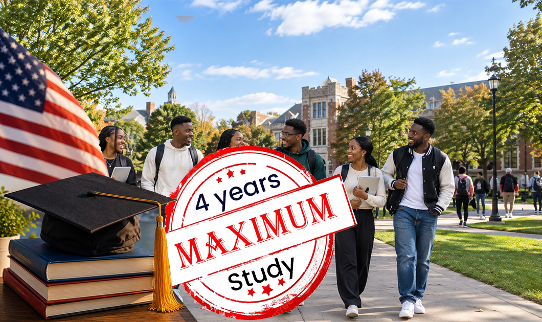
The new rules will generally limit F-1 admission to the length of a student’s programme, up to a maximum of four years, while reducing the period students have to prepare for departure after completing their studies or authorised post-completion practical training from 60 days to 30 days.
The changes are particularly relevant to international students whose programmes take longer than expected or who intend to continue their studies, change educational objectives or undertake certain forms of practical training after graduation.
F-1 Students Will No Longer Be Admitted for “Duration of Status”
Under the existing system, F-1 students are generally admitted for the duration of status, meaning they may remain in the United States while maintaining valid student status and pursuing their authorised programme of study or practical training.
Under the new rule, DHS will replace this arrangement with a fixed period of authorised admission.
The admission period will generally correspond to the length of the student’s programme as indicated on the relevant Form I-20, subject to a maximum of four years.
Students who require additional time beyond their authorised admission period will generally need to apply for an Extension of Stay (EOS) or obtain a new admission period by travelling outside the United States and seeking readmission where permitted.
The Four-Year Maximum
The new rules establish a maximum admission period of four years for F-1 students, although the actual period granted may be shorter depending on the length of the programme.
This means:
- Students enrolled in programmes shorter than four years may receive an admission period corresponding to their programme length.
- Students whose programmes extend beyond four years may need to seek an extension.
- Students who require additional time because of certain academic or other qualifying circumstances may need to apply for an extension of stay.
- Students who timely file an eligible extension application may generally continue their authorised course of study while the application is being adjudicated.
The change means students can no longer rely on the previous open-ended duration-of-status arrangement when their studies extend beyond their initial authorised admission period.
Post-Study Grace Period Reduced to 30 Days
Another significant change concerns the period students have to prepare for departure after completing their studies or authorised post-completion practical training.
Under the previous arrangement, F-1 students generally had 60 days to prepare to leave the United States, transfer to another school or take other permitted immigration action. The new rule reduces this period to 30 days.
Students who complete their programme should therefore pay close attention to the applicable end date and ensure that they take the necessary immigration steps within the permitted timeframe.
Students Who Need More Time May Apply for an Extension
Students whose programmes require additional time will not automatically lose the ability to remain in the United States. Instead, they may need to apply for an Extension of Stay through the appropriate process.
Students seeking additional time may need to:
- Consult their Designated School Official;
- Obtain the required documentation supporting the extension;
- Submit the appropriate application to US Citizenship and Immigration Services (USCIS); and
- Complete biometric requirements where applicable.
Department of Homeland Security has also provided for circumstances in which students may seek a new admission period after travelling outside the United States, subject to the applicable immigration requirements.
English Language Students Face a 24-Month Limit
The new rules also establish a specific limit for students enrolled in English language training programmes. F-1 students in English language programmes will generally be limited to an aggregate admission period of 24 months, including applicable breaks and annual vacation periods. Students pursuing this type of programme should therefore consider the shorter maximum period when planning their studies and any subsequent academic plans in the United States.
The rules governing F-1 students attending public secondary schools remain subject to a separate statutory limitation. International students attending a US public high school are generally limited to 12 months of study at public high schools in the United States.
The new fixed-admission framework does not remove this existing statutory limitation.
What This Means for Nigerian Students
The changes are particularly relevant to Nigerian students planning to study in the United States, especially those enrolling in programmes that may involve lengthy academic or practical-training periods.
Students should now pay closer attention to:
- The admission period granted at entry;
- The programme end date stated on their Form I-20 and any extension requirements;
- The end date of authorised practical training; and
- The reduced 30-day period for departure or other permitted immigration action.
Students whose programmes are likely to extend beyond their initial admission period should discuss their circumstances with their school’s international student office well before their authorised stay expires.
Students Planning OPT or STEM OPT Should Plan Carefully
The changes may also affect students intending to undertake Optional Practical Training (OPT) or STEM OPT after completing their academic programmes.
DHS has included provisions addressing students seeking extensions of stay in connection with post-completion OPT and STEM OPT. The final rule also provides a limited transition period for certain students applying for employment authorisation during the first six months after the rule takes effect.
Students should therefore avoid assuming that completion of their academic programme automatically gives them the same period of authorised stay that applied under the previous duration-of-status system.
Students Should Monitor Their Immigration Status
The shift to fixed admission periods places greater importance on monitoring immigration documents and deadlines.
Students should ensure that they:
- Keep their Form I-20 and SEVIS records up to date;
- Maintain communication with their school’s designated international student officials;
- Understand the date until which they are authorised to remain in the United States;
- Begin extension procedures early where additional time is required; and
- Avoid remaining in the United States beyond their authorised period without taking the required immigration action.
A failure to maintain lawful status can create immigration consequences and may affect future visa or admission applications.
A Significant Change for International Students
The new rules represent a shift away from the long-standing duration-of-status framework for F-1 students.
DHS says the fixed-period system is intended to provide greater oversight of F, J and I nonimmigrants and allow immigration authorities to periodically assess whether individuals are maintaining the conditions of their status.
For students, however, the practical implication is that completing a programme within the authorised period and monitoring immigration deadlines will become increasingly important.
Key Takeaway
The new US F-1 rules introduce a more clearly defined timeframe for international students.
F-1 students will generally be admitted for the length of their programme, up to four years, while the post-study departure period will be reduced from 60 days to 30 days.
Students who require additional time may need to apply for an extension of stay or take other permitted immigration steps before their authorised admission period expires.
For Nigerian students planning to study in the United States, the key lesson is straightforward:
Do not rely solely on the duration of your academic programme. Understand your authorised admission period, monitor your deadlines and plan early if additional time will be required.