
Assalamu Alaikum wa Rahmatullahi wa Barakatuh.
Over the past three editions of our Newsletter, we have explored the enduring power of waqf from different perspectives; how a self-sufficient mosque can become a lasting source of community impact, the practical challenges of establishing and managing family waqf, and how a Waqf Family Business can preserve wealth, empower heirs, and secure continuous reward.
This edition broadens the conversation.
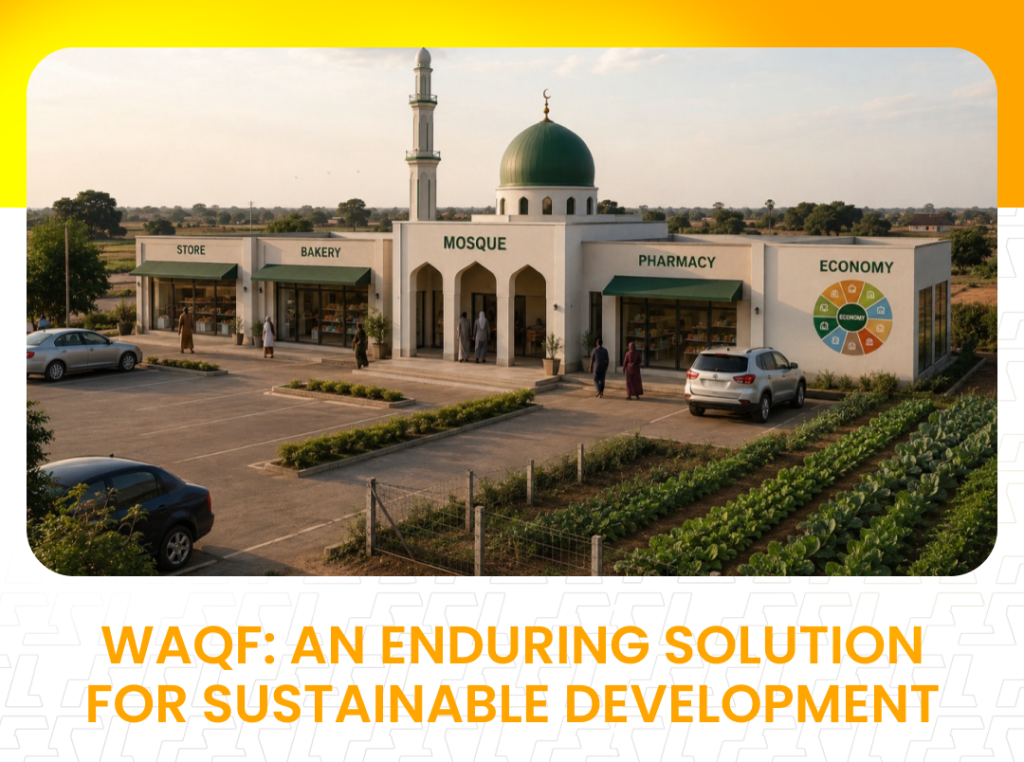
What if waqf could do even more? What if it could become a catalyst for national development—strengthening education, healthcare, agriculture, entrepreneurship, and social welfare—while reducing excessive dependence on government?
As Muslims, we inherit a rich tradition of building resilient communities through collective responsibility and perpetual charity. Waqf is one of Islam’s most powerful institutions for turning private wealth into public good and temporary assets into lasting legacies.
In the insightful article that follows, Abbas Adam Abba examines why reviving the institution of waqf is not merely an act of charity, but a strategic pathway to sustainable community development.
The late renowned Islamic scholar, Yusuf al-Qaradawi, once stated:
“Waqf is one of the greatest mechanisms for reducing society’s dependence on government, because it enables people to solve their own problems through sustainable charitable endowments.”
This statement is particularly relevant when we examine the situation of Nigeria today.
In 2026, Nigeria marks approximately 66 years of independence and over 27 years of uninterrupted democratic governance. Yet, the mindset of many citizens—and even some leaders—remains that almost everything must be provided by the government.
When schools deteriorate, people wait for the government. When hospitals lack equipment, people wait for the government. When young people are unemployed, people wait for the government. When roads are damaged or citizens face hardship, people wait for the government.
This mentality has turned many communities into passive recipients of assistance rather than active providers of solutions.
Throughout Islamic history, waqf has been one of the major pillars of social and economic development.
Through waqf, communities established:
- Schools
- Universities
- Libraries
- Water wells
- Orphanages
- Student support programs
- Research and innovation centers
In many instances, these institutions were neither built nor maintained by governments. Rather, wealthy individuals, scholars, merchants, and ordinary members of society established endowments for the benefit of the public.
For example, Al-Azhar University flourished for centuries through waqf support. Likewise, many of the world’s leading universities and educational institutions have benefited from endowment systems that resemble the waqf model.
Across Europe, America, the Middle East, and Asia, numerous institutions maintain large endowment funds that support their operations without relying solely on government budgets.
One of our greatest challenges is the absence of a strong culture of community ownership and responsibility.
People desire development, yet many see the government as the sole provider of it.
In reality, no government alone can meet the needs of millions of citizens.
Even countries with strong economies do not depend exclusively on government funding for education, healthcare, research, youth development, or social welfare.
Instead, they promote collaboration among:
- Government institutions
- Private companies
- Wealthy individuals
- Civil society organizations
- Mosques and religious institutions
- Local communities
It is this partnership that produces sustainable development.
If waqf is properly revived and developed in Nigeria, it can facilitate:
1. Educational Waqf
Schools and universities can establish waqf funds whose returns support:
- Teachers and lecturers
- Laboratories and educational facilities
- Scholarships for underprivileged students
2. Healthcare Waqf
Hospitals can establish waqf funds to:
- Purchase medicines
- Assist poor patients
- Build and maintain medical facilities
3. Agricultural Waqf
Agricultural endowments can:
- Produce food
- Train young people
- Create employment opportunities
4. Commercial Waqf
Shops, houses, and other waqf properties can be established, with rental income or profits used to finance community development projects.
5. Cash Waqf:
Whether a person contributes ₦500, ₦5,000, or ₦50,000, they can participate in a family waqf, a religious institution’s waqf fund, or a community waqf fund. Such contributions can be pooled into a sustainable investment fund that benefits society for generations.
*How Government and Society Can Work Together.
The promotion of waqf does not mean that the government should withdraw from its responsibilities. Rather, what is needed is cooperation between government and society.
The government can:
- Enact laws that encourage waqf development.
- Provide tax incentives for waqf donors.
- Establish simple and transparent registration processes for waqf institutions.
- Protect waqf properties from corruption, mismanagement, or unlawful appropriation.
- Partner with waqf organizations in delivering educational, healthcare, and social services.
On the other hand, members of society can:
- Dedicate a portion of their wealth as waqf.
- Establish cash waqf funds through mosques.
- Create educational endowment funds in schools and universities.
- Develop community waqf initiatives.
- Encourage youth participation in volunteer activities related to waqf management and development.
Conclusion
Nigeria cannot achieve sustainable and comprehensive development if we continue to believe that government alone must do everything.
True and lasting development requires cooperation between government and society.
Waqf is a system introduced by Islam many centuries ago to enable communities to take ownership of their own development. Examples include the agricultural land endowed by Umar ibn al-Khattab and the famous Well of Rumah endowed by Uthman ibn Affan, both of which were encouraged and endorsed by Prophet Muhammad (peace be upon him).
The time has come for us to revive this noble tradition. We should establish schools, hospitals, farms, commercial properties, libraries, and cash waqf funds that will continue to benefit society for generations.
If government and citizens work together to build effective waqf institutions, we can reduce dependency, promote responsibility, and achieve sustainable development for our communities and future generations.
“Let us not only ask what the government can do for us; let us also ask what we can do for our communities through waqf.”
May Allah grant us the ability to revive the Sunnah of waqf and reduce excessive dependence on government, thereby strengthening our communities and creating lasting benefits for future generations. Ameen.
Credit;
Abbas Adam Abba
Chairman, Alburhan Waqf Initiative, Kano
Tel: +234 803 856 9777
Email: abbasadamrz@gmail.com
Fiduciary Services Limited is committed to assisting Muslim clients in aligning their estate and business affairs with Islamic principles. Contact us today to ensure your legacy reflects your faith and values.
Get in touch with one of our professionals today by sending an email to contact@fiduciaryservicesltd.com. To book a FREE CONSULTATION click link: bit.ly/4sjQDLV
Shukran Jazeelan for reading.
Mercy Edukugho-Aminah
mercyaminah@fiduciaryservicesltd.com
+234 803 726 5961
Click on the flyer below to take the Family Business Pledge

Click on the flyer below to take the Survey