

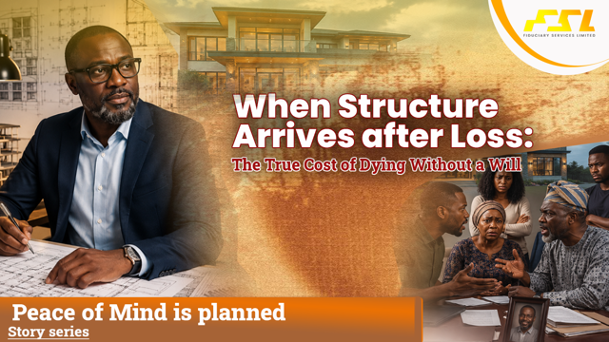
Welcome back to our “Peace of Mind is Planned” story series.
Our last edition was a discussion on “The Structure That Brought the Family Back Together”; the story portrays that family fragmentation rarely begins with the transfer of wealth. It begins much earlier — with unclear expectations, undocumented values, competing visions, poor communication, and the absence of a deliberate succession process
In this edition, we discuss “When Structure Arrives After Loss”.
There is a conversation many successful Patriarchs and Matriarchs postpone.
Not because they do not care about their families, but because talking about death can feel premature, uncomfortable, or simply unnecessary.
The conversation is:
“What happens to everything I own and have built when I am no longer here to manage it or give instructions?”
For the Patriarch of the Ajayi family, that conversation came too late.
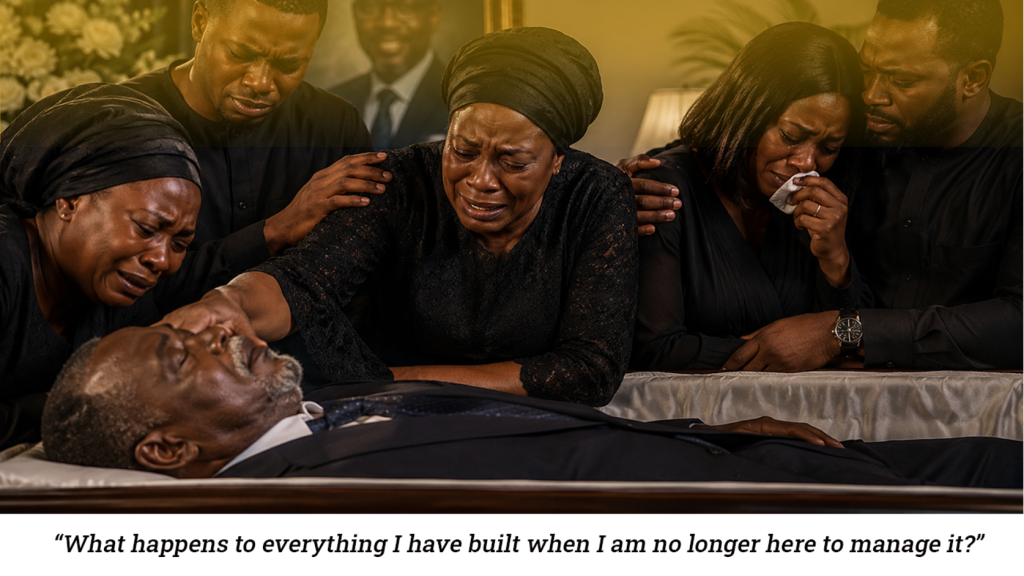
The Sudden Loss
Mr. Ajayi was a successful entrepreneur, devoted husband and father, and the architect of the acquisition of substantial family assets (estate).
Over the years, he had accumulated properties, investments, business interests and offshore assets.
Like many people who spend their lives building wealth, he believed there would always be time to put the necessary structures in place.
There was not.
His death was sudden.
He left no Will, no comprehensive inventory of his assets and no clear succession framework to guide his family through the administration of his estate.
The family was therefore left to deal with two realities at once:
Grief and Uncertainty.
Banks required documentation the family did not have.
Different family members had different understandings of the estate.
Questions arose about assets, ownership and access.
Well-meaning relatives offered conflicting advice.
And, beneath it all, there was a growing fear that the process of administering the estate could create divisions within the family.
The widow captured the situation simply:
“I don’t know how to do this, and I don’t want us to fight.”
That sentence captures one of the often-overlooked consequences of inadequate estate planning.
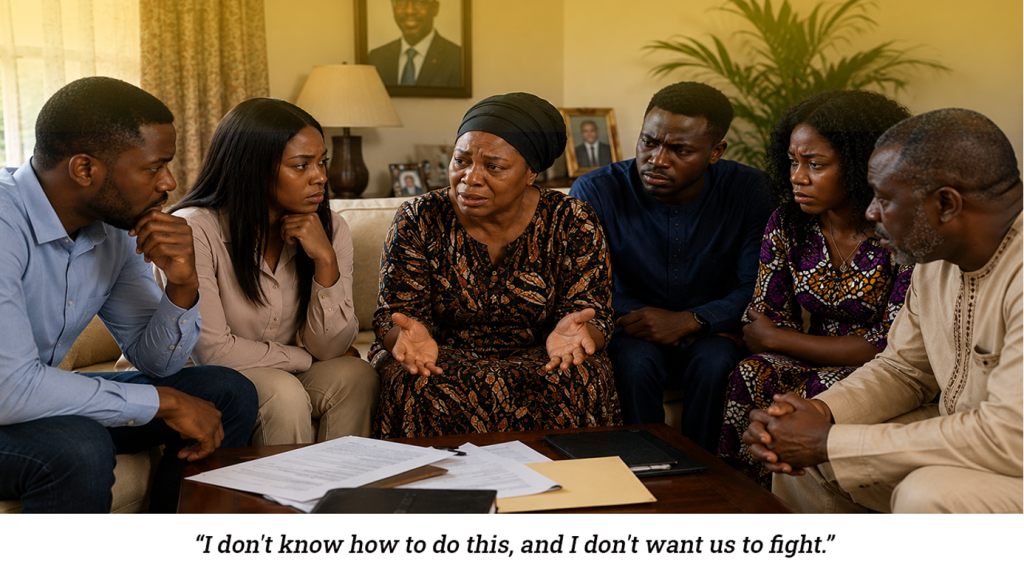
The absence of structure can turn an administrative process into a family crisis.
When Structure Stepped In
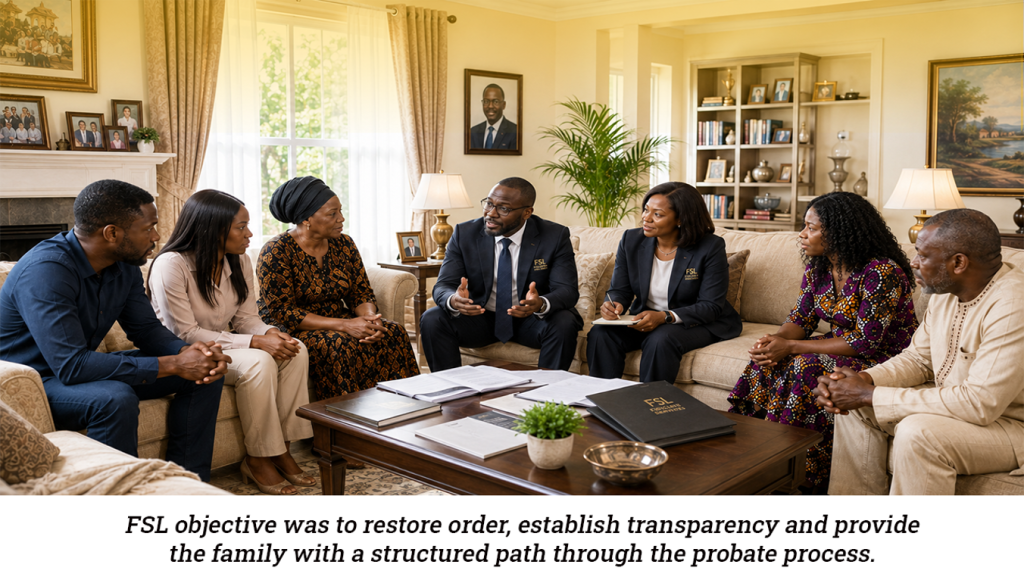
As valuable Advisors, we were subsequently engaged to support the family through the estate administration process.
The objective was not simply to process documents.
It was to restore order, establish transparency and provide the family with a structured path through the probate process. Hence, we:
1. Set out (established) a clear roadmap
The first priority was to replace uncertainty with clarity.
The estate was assessed, relevant information was gathered and the probate process was mapped out so that the family understood what needed to happen, in what sequence and why.
2. Document the assets – what makes up the estate
An estate can be considerably more complex than the assets a family knows about.
Properties, bank accounts, investments, business interests, insurance policies, digital assets and offshore holdings may all form part of the wider estate picture.
The process therefore involved identifying, tracing, verifying and documenting relevant assets and liabilities.
3. Provided professional interface and intermediation
Banks, professional advisers, claimants and other relevant parties could communicate through an organised process rather than placing additional administrative pressure on the bereaved family.
This created space for the family to grieve while the necessary administrative and professional processes continued.
4. Championed transparency within the family
In estate administration, uncertainty can quickly become suspicion.
Regular and transparent communication helped the family understand what had been identified, what was being processed and what remained outstanding.
This reduced the room for assumptions and helped preserve trust among family members.
5. Maintained legal and procedural discipline
Probate and estate administration require careful attention to documentation, authority and applicable legal procedures.
A structured approach helped minimise avoidable errors, delays and disputes while ensuring that the administration process remained properly documented.
6. Undertook the administrative burden
Perhaps most importantly, the family did not have to navigate every procedural requirement while simultaneously processing their loss.
They had professional guidance throughout the process, allowing them to focus on their family rather than becoming overwhelmed by administrative concerns.
The Transformation
Six months later, the outcome was not simply that the estate transmission was progressing.
The family was still united.
The anticipated arguments had not materialised.
The widow no longer felt overwhelmed and had confidence to support the process.
Family decisions could be made with greater clarity.
And members of the family had a clearer understanding of what was happening and why.
At a family meeting, the eldest son expressed what the experience had ultimately meant to them:
“Fiduciary Services Limited didn’t just help us sort Daddy’s estate. They protected our family.”
That is the deeper purpose of good estate administration.
It is not merely about transferring assets.
It is about protecting relationships while transferring wealth.

Dying without a Will does not automatically mean that an estate will descend into chaos.
But the absence of a Will can make the process more complex, particularly where there are significant assets, multiple beneficiaries, business interests, investments, or assets spread across different jurisdictions.
More importantly, estate planning is not only about what happens to your assets. It is about what happens to the people you leave behind.
With the right structures and professional guidance, families can:
- Navigate loss without unnecessary conflict;
- Administer an estate with greater clarity;
- Reduce uncertainty among beneficiaries;
- Protect family relationships;
- Preserve the value of accumulated wealth; and
- Create a more orderly transition of assets across generations.
Mr. Ajayi did not leave a Will.
But his family’s experience offers an important lesson:
The best time to create structure is before your family needs it.

If you are a business owner, professional, investor or family wealth holder, consider these four steps:
- Document your assets.
Maintain an updated record of your properties, bank accounts, investments, businesses, insurance policies, digital assets and other significant holdings. - Have a Will.
A Will is not an invitation to think about death. It is an instruction to your family about what should happen when you are no longer there to give those instructions yourself. - Choose your executor carefully.
The person responsible for administering your estate should have the integrity, capacity and competence required to carry out that responsibility. - Build an estate plan, not merely a Will.
For families with substantial or complex wealth, a Will may be only one component of a broader succession and wealth-preservation strategy.
Grief is difficult enough.
Estate administration should not make it harder.
The question is not whether your family will eventually need a plan.
The question is:
Will they have to create that plan while grieving your loss?
Question Poser: What has your experience been?
Have you seen families struggle because there was no clear estate plan? Or have you seen proper planning bring clarity and peace during a difficult time?
Share your perspective below — and send this to someone in your family who needs to have “the conversation” before it becomes urgent.
Start the conversation, send an email to: contact@fiduciaryservicesltd.com

It is titled “The Structure That Kept the Company as a Going Concern” which will certainly arrive in your inbox as usual.
Thank you for reading!
A QUICK QUESTION BEFORE YOU CLOSE THIS
Could Your Family Access Everything You’ve Built?
Most of us are working hard to build something for the people we love. But if you weren’t around, would they know where it all is, and could they carry out your wishes without stress or confusion?
Most people assume they’re covered. Then they look closer and find gaps they didn’t see coming.
The Family Legacy Readiness Score shows you where you stand in a few minutes: how ready your family is, what’s missing, and what to fix first.

As part of our Wealth Preservation services, we have experienced advisors ready to assist you in developing an estate plan that protects, preserves, and sustains you and your family’s wealth for generations.
Get in touch with one of our professionals today by sending an email to contact@fiduciaryservicesltd.com. To book a FREE CONSULTATION click link: bit.ly/4sjQDLV
Regards,
Mercy Edukugho-Aminah
mercyaminah@fiduciaryservicesltd.com
+234 803 726 5961