
Assalamu Alaikum wa Rahmatullahi wa Barakatuh.
Its mid-year already! January feels like it was just yesterday.
At the start of the year we shared our Peace of Mind Planning and Well-Being Checklist reminding us to be intentional and deliberate about clarity, purpose, peace of mind, continuity, control, and confidence across all aspects of personal, family, business, and financial life.
As we commence the second half of the year, once again, we encourage you to assess what matters most; your family, assets, investments, business, and legacy, and identify any gaps that required attention.
Have you taken the steps you intended?
Have your estate and legacy plans been updated?
Are your family and business structures still fit for purpose?
Have you made the decisions today that will give you peace of mind tomorrow?
If you would like to review your plans, discuss you or your family’s unique circumstances, or explore how to better protect your wealth and legacy, book a confidential session with one of our advisors today (Book Here). Sometimes, one conversation is all it takes to turn good intentions into lasting action.
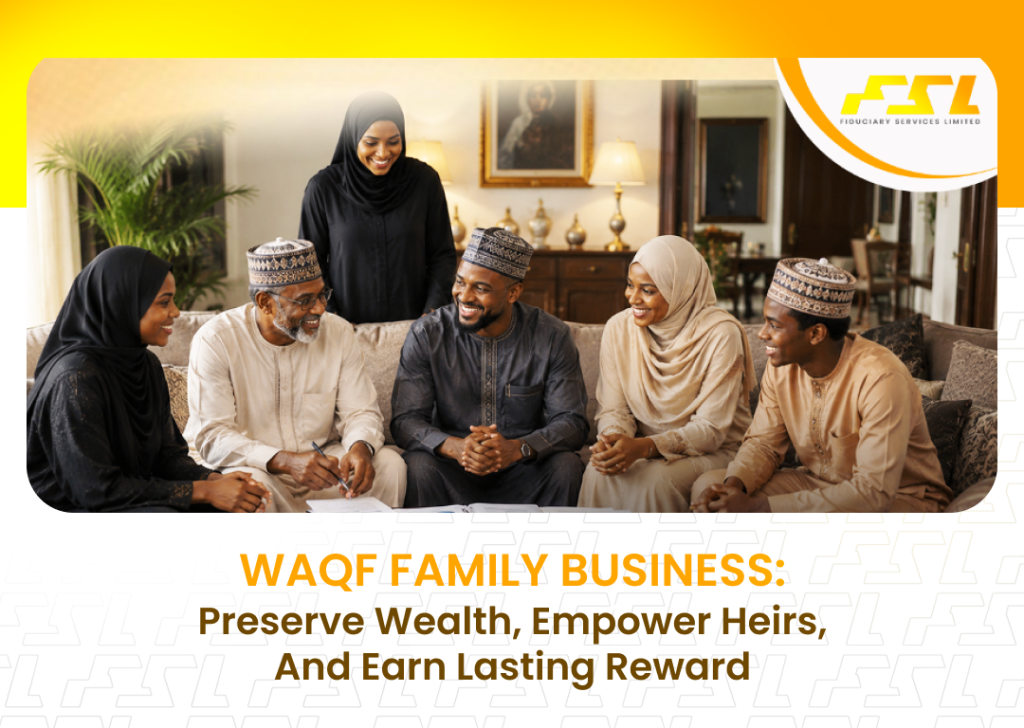
Now, lets explore today’s topic viz: Waqf Family Business Models (Al-Waqf Al-Ahli): Building Legacy with Islamic Principles, where Professor Mustapha Abubakar examines how the centuries-old institution of Waqf can be adapted to modern family businesses.
Al-Waqf al-Ahli, or the Family Waqf, is an Islamic endowment structure where assets are dedicated to benefit specific family members for generations. Unlike a conventional family trust, a Waqf is permanent and irrevocable — assets cannot be sold, inherited, or reverted to individuals. The family acts as custodians, not owners.
The result: Financial security for your descendants, protection from fragmentation under Islamic inheritance, and continuous sadaqah jariyah [ongoing charity].
Modern Waqf has evolved from static land holdings into dynamic, commercial structures. Below are 5 proven models you can adopt, depending on your family’s assets, skills, and goals.
1. Direct Ownership & Management Model
How it works: The family dedicates a productive asset — rental properties, farmland, or a workshop — as Waqf. A family-appointed Nazhir runs the business directly. Net profits are paid to eligible heirs on a pre-agreed schedule, such as monthly stipends. [manager]
Best for: Small to medium assets where the family has hands-on operational expertise.
Advantages
- Simple to establish with minimal setup cost
- Full control remains within the family
- No third-party management fees
Challenges
- Requires active management skills and time
- Risk of family disputes over profit distribution
- Limited access to growth capital without diluting the Waqf
2. Hybrid Cash Waqf Model
How it works: Family members contribute cash into a Waqf pool. The pool provides interest-free loans [Qard Hasan] or equity-like financing [Mudarabah] to family-run micro-enterprises. As businesses repay, the capital recycles, and a portion of the returns is distributed to beneficiaries.
Best for: Families with multiple small entrepreneurs — traders, artisans, or freelancers.
Advantages
- Promotes self-employment and entrepreneurship
100% Sharia-compliant: no riba - Capital is revolving, not consumed[interest]
Challenges
- Higher default risk if businesses fail
- Requires disciplined loan monitoring and record-keeping
- Not suitable for large-scale capital projects
3. Integrated Corporate Waqf Model
How it works: A family operating company dedicates a portion of shares — e.g., 30% — as perpetual Waqf. The Waqf holds those shares, receives dividends, and distributes them to family beneficiaries. The remaining 70% of shares can be inherited normally under Islamic law.
Best for: Established family businesses with a formal corporate structure.
Advantages
- Solves inheritance fragmentation: the business stays whole and operating
- Creates a stable, long-term dividend flow for heirs
- Separates ownership from management for professionalism [Waqf]
Challenges
- Complex legal setup, especially in non-Muslim jurisdictions
- Share valuation can be disputed over time
- Requires strong corporate governance and transparency
4. Platform-Based Investment Model
How it works: The family trust pools Waqf cash and invests through Sharia-compliant platforms — Islamic REITs, Sukuk funds, or Wakala arrangements. Only the profits are distributed monthly or quarterly. The principal remains protected forever.
Best for: Families with liquid cash who prefer passive income without operations.
Advantages
- Truly passive income with professional asset management
- Highly liquid and easy to scale up or down
- Diversified exposure reduces single-asset risk
Challenges
- Market risk: returns can fluctuate
- Platform/management fees reduce net yield
- Requires due diligence to ensure instruments are genuinely Sharia-compliant
5. Hybrid Charity-Family Model
How it works: The Waqf deed specifies a fixed allocation, for example, 70% to family members and 30% to charity — a mosque, school, or healthcare initiative. A family Nazhir manages both. If the family line ends, 100% shifts to charitable causes.
Best for: Families who want both financial security and lasting religious reward.
Advantages
- Guarantees perpetual community benefit.
- Balances family welfare with Islamic encouragement of charity.
- Protects the Waqf’s purpose even if descendants pass away
Challenges
- Lower immediate income for family beneficiaries.
- Potential disagreements on what qualifies as “charitable”.
- Requires very clear, watertight deed language
1. Draft the Waqf Deed
Define the asset, beneficiaries [e.g., “my children and their descendants”], distribution ratios, and succession rules. This is the legal and spiritual foundation.
2. Transfer Legal Ownership
The asset moves from individual ownership to the Waqf. This transfer is irrevocable.
3. Appoint a Nazhir
Choose a manager — a family council, board of elders, or a professional trustee — to oversee operations and distributions.
4. Register the Waqf
In Muslim-majority countries, register with the Awqaf Ministry. Elsewhere, use a trust or foundation structure to ensure legal recognition.
Critical Consideration
A Waqf is permanent. Once established, the family manages the asset but does not own it. This is why succession planning, clear governance, and professional management are not optional — they are essential for the Waqf to survive and thrive across generations.
Start your family’s legacy today.
Waqf Family Business combines financial wisdom with Islamic ethics: protecting wealth, avoiding fragmentation, and creating impact that outlives you.
Credit:
Professor Mustapha Abubakar
Dept of Finance
Ahmadu Bello University Business School.
Director, Research and Development
Institute of Islamic Banking and Finance, Abuja, Nigeria.
08065428153; 08023638823
islamicbankingnigeria.com
Fiduciary Services Limited is committed to assisting Muslim clients in aligning their estate and business affairs with Islamic principles. Contact us today to ensure your legacy reflects your faith and values.
Get in touch with one of our professionals today by sending an email to contact@fiduciaryservicesltd.com. To book a FREE CONSULTATION click link: bit.ly/4sjQDLV
Shukran Jazeelan for reading.
Mercy Edukugho-Aminah
mercyaminah@fiduciaryservicesltd.com
+234 803 726 5961
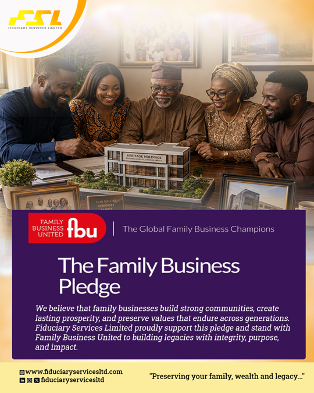
Click on the flyer below to take the Family Business Pledge
Click on the flyer below to take the Survey